


Deepfakes, Free Speech, and State Control: Where Should India Draw the Line?

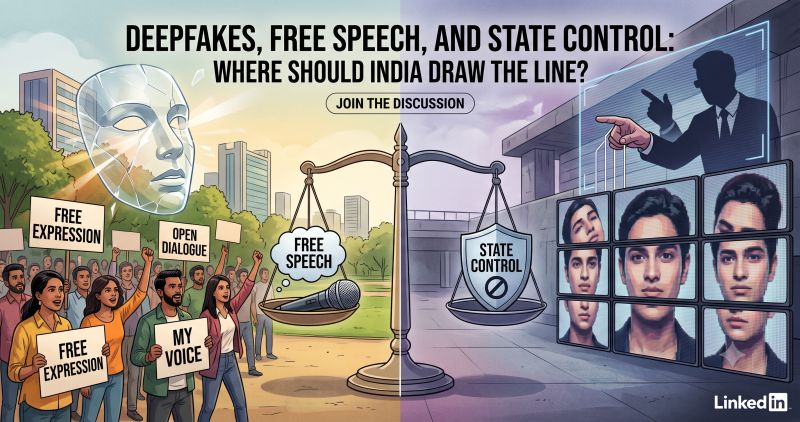
Artificial Intelligence has transformed the way we create, consume, and share information. Among its most controversial developments is the rise of deepfakes—highly realistic AI-generated images, audio, and videos capable of imitating real people with remarkable accuracy.
While the technology itself is neutral, its misuse has created significant legal, ethical, and societal concerns. As deepfakes become increasingly sophisticated, India finds itself at a critical crossroads: how do we protect citizens from harm without undermining the fundamental right to free speech?
The Growing Threat of Deepfakes
Deepfakes are no longer limited to internet pranks or experimental technology. They are now being used in ways that can have serious consequences for individuals, institutions, and even democracies.
Common forms of misuse include:
- Financial fraud and impersonation scams
- Political misinformation and election manipulation
- Non-consensual intimate content and digital sexual abuse
- Defamation and reputational harm
- Threats to national security and public order
The ability to fabricate convincing digital content has blurred the line between truth and fiction, creating challenges for governments, businesses, media organisations, and citizens alike.
India’s Current Legal Framework
Unlike some jurisdictions that are developing dedicated AI legislation, India currently addresses deepfakes through a combination of existing laws.
The legal framework includes:
- The Bharatiya Nyaya Sanhita, 2023 (BNS)
- The Digital Personal Data Protection (DPDP) Act, 2023
- The Information Technology Act, 2000
These laws collectively address issues such as identity theft, forgery, misinformation, cybercrime, privacy violations, and the dissemination of harmful content.
The DPDP Act places significant emphasis on consent and personal data protection, while provisions of the IT Act and criminal law provide mechanisms to prosecute offenders and remove unlawful content.
Learning from Global Approaches
Globally, policymakers are grappling with similar concerns.
The European Union’s AI Act places a strong emphasis on transparency, requiring AI-generated content to be appropriately disclosed in many contexts. Similarly, the Digital Services Act promotes accountability among online platforms and facilitates the removal of illegal content.
These frameworks reflect a broader international trend: rather than prohibiting AI technologies outright, governments are seeking to create safeguards that encourage innovation while protecting public trust.
The Constitutional Challenge
At the heart of the deepfake debate lies a fundamental constitutional question.
India’s Constitution guarantees freedom of speech and expression under Article 19(1)(a). However, this right is not absolute. Reasonable restrictions may be imposed in the interests of public order, security, decency, morality, and other constitutionally recognised grounds.
The challenge therefore is not simply whether deepfakes should be regulated. The real question is how regulation can effectively prevent harm without becoming a tool for excessive censorship or state overreach.
On one side lies the promise of technological innovation and digital creativity. On the other lies society’s need for authenticity, trust, and access to accurate information.
The Road Ahead
India currently relies on a fragmented set of legal provisions rather than a dedicated deepfake regulatory framework. As artificial intelligence continues to evolve, policymakers may need to consider whether a more comprehensive approach is necessary.
Any future framework should aim to:
- Protect individuals from fraud, harassment, and exploitation
- Preserve democratic processes and public trust
- Encourage responsible innovation
- Safeguard constitutional freedoms
- Promote transparency and accountability in AI-generated content
Conclusion
As the world’s largest democracy, India faces a unique responsibility. The challenge is not choosing between technology and freedom, or between innovation and regulation. Rather, it is about finding a balance that allows all of these values to coexist.
Deepfake regulation is ultimately about more than controlling technology. It is about preserving trust, protecting rights, and ensuring that technological progress remains aligned with the democratic principles upon which our society is built.
The question is no longer whether deepfakes should be regulated. The question is how India can regulate them wisely.
The author, Dr. Pallavi Divekar is a Partner of Divekar and Co. established in 1921. Do visit our website www.divekarandco.com